

By Ehtijad Ali
Updated: October 2026
Reading time: about 7 minutes
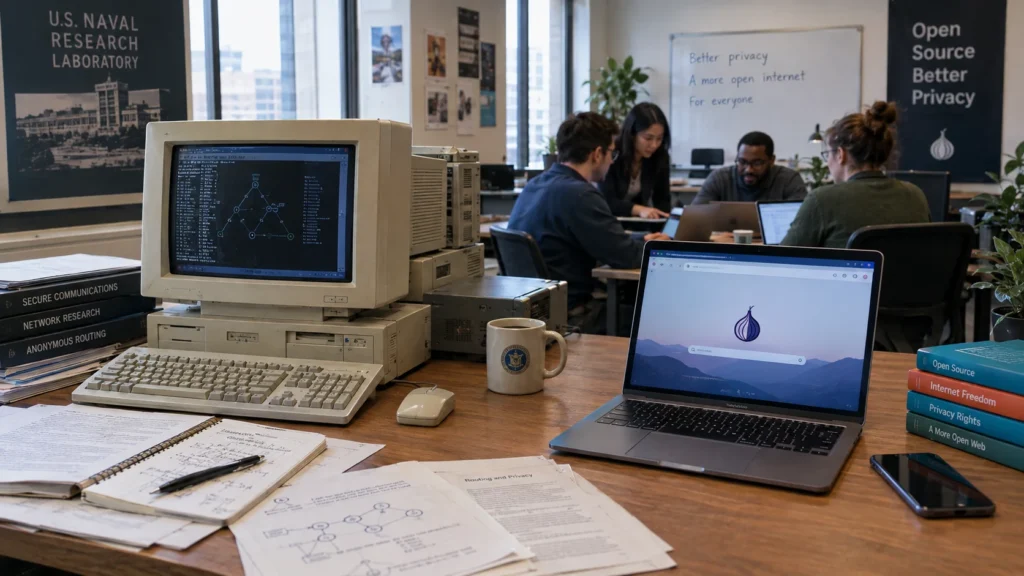
Tor Browser is often associated with the dark web, but its history started long before the dark web became a popular subject online. Its roots go back to research at the United States Naval Research Laboratory in the 1990s, when researchers were looking for ways to make internet communications harder to trace.
The project did not have a single creator. David Goldschlag, Michael G. Reed, and Paul Syverson worked on the early onion-routing research. Later, Roger Dingledine and Nick Mathewson helped develop the Tor project that people know today.
Understanding these different stages helps explain who created Tor, why it was developed, and how a research project became a privacy tool used around the world.
Who created Tor Browser?
Tor began with onion-routing research in 1995 by David Goldschlag, Michael G. Reed, and Paul Syverson at the US Naval Research Laboratory. In the early 2000s, Roger Dingledine, working with Syverson, helped develop the next generation of the project. Nick Mathewson joined the team soon after.
The Tor network was first deployed in October 2002. The Tor Project, the nonprofit organization that maintains and develops Tor software, was established in 2006. Tor Browser came later, with development beginning in 2008.
These dates describe different milestones: the original research, the public network, the nonprofit organization, and the browser. They are related, but they are not the same thing. The official history of Tor explains how the project developed.
What is onion routing?
Onion routing is a way of sending internet traffic through multiple relays so that one computer does not need to know the entire route. Tor uses layers of encryption to limit what each relay can learn about a connection.
Think of a package travelling through several sorting centres. Each centre has enough information to send it to the next stop, but it does not necessarily know the complete journey. Tor applies a related idea to network traffic, using encryption and relays rather than physical packages.

This design can make it harder for a website to identify a visitor’s usual IP address or for a local network observer to see which websites the visitor accesses. However, Tor does not make every activity anonymous. Signing in to a personal account, sharing identifying details, or using an unsafe device can still reveal information.
For a closer look at the process, read our guide on how Tor works.
Why did the US Navy research onion routing?
When people think about online privacy, they often focus on the contents of a message. But information about a connection can also reveal something important. Even if a message is encrypted, an observer may still see which computers communicate, when they connect, and how frequently data moves between them.
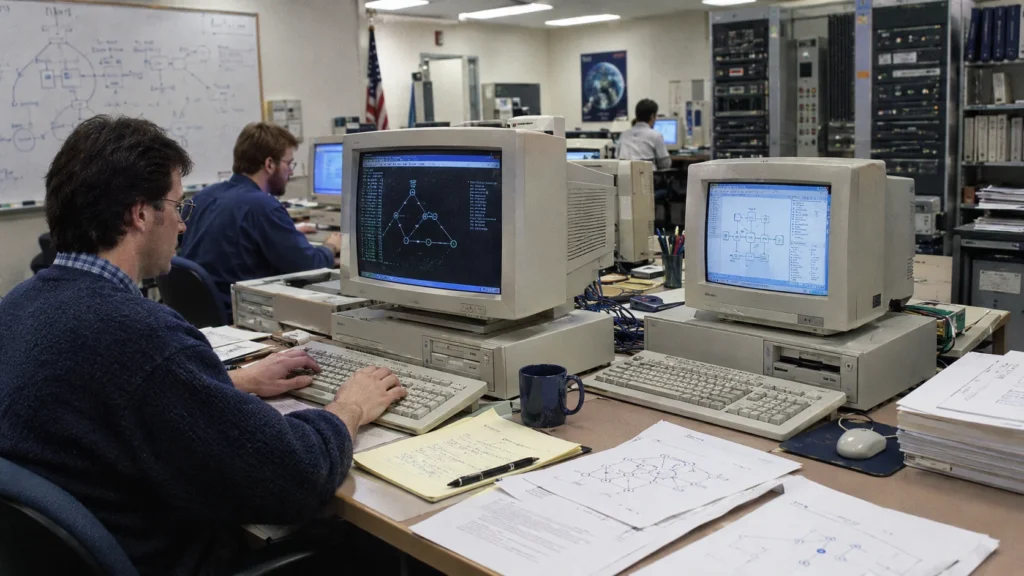
In 1995, David Goldschlag, Michael G. Reed, and Paul Syverson began developing onion-routing designs and prototypes at the Naval Research Laboratory. Their work explored how network connections could be made harder to trace, even when someone was observing the traffic.
The original research was not the same as the modern Tor Browser. It provided an important foundation for later development. The project evolved as developers worked on the software, the network, and ways to make the technology useful to a wider audience.
For related background, see our article on the history of the cypherpunks and encryption.
How did Tor become a public project?
In the early 2000s, Roger Dingledine worked with Paul Syverson on a new generation of onion-routing software. Nick Mathewson joined the effort and became another key contributor. The name Tor came from “The Onion Routing,” although the project uses the spelling “Tor,” not “TOR.”
The Tor network was first deployed in October 2002, and its code was made available under a free and open software licence. This allowed people to inspect the software, use it, and contribute to its development.
By the end of 2003, the network had around a dozen volunteer nodes. That was a small beginning, but it established the basis for a network that could grow beyond a single research team.
In 2004, the Electronic Frontier Foundation (EFF) began funding work on Tor. In 2006, The Tor Project became an independent nonprofit organization responsible for supporting the software’s continued development.
These changes mattered because Tor was designed as a distributed network rather than a service that depends on one central operator. Its software and volunteer-run relays became part of a wider community effort.
When was Tor Browser created?
The Tor network and Tor Browser are connected, but they serve different roles. The network routes traffic through relays. Tor Browser gives ordinary users a practical way to browse through that network without having to configure each part themselves.
Development of Tor Browser began in 2008. The browser made the technology more accessible to people who were not comfortable setting up privacy software manually. Tor also began developing bridges in 2007. Bridges are entry points that are not listed like ordinary public relays and can help users connect when access to Tor is blocked.
These developments helped make Tor useful to journalists, researchers, activists, and people who wanted to reduce online tracking or reach blocked information. Tor is not exclusively a dark web browser: it can also access ordinary websites.
You can download the software from the official Tor Project website. Avoid unofficial installers that could put your device or privacy at risk.
Who funds the Tor Project today?
Tor’s funding history is another reason people ask about its origins. The early research took place at a US Navy laboratory, and the EFF later supported development. Today, The Tor Project reports receiving support from a mix of government grants, private foundations, and individual donors.
Government funding is part of that history, but it does not by itself establish that a government controls the entire public network. Funding, software development, and the operation of volunteer relays are different things.
Funding arrangements can change, so check the nonprofit’s official funding information for its current supporters rather than relying on old claims or rumours.
What can Tor protect you from?
Tor can help reduce the ability of websites and local network observers to connect your browsing activity with your usual internet address. It can also help people access information when a network blocks certain websites.
However, it is not a guarantee of complete anonymity. A website can still recognise an account when you sign in. Information you voluntarily share can identify you, and a compromised device may expose activity outside the protection Tor provides.
Tor is also different from incognito mode. Private browsing in a regular browser mainly limits what is saved locally; it does not provide the same network-routing protections. Our guide explains more about whether incognito mode is private.
Use the official, up-to-date Tor Browser and follow the project’s security guidance. Your browsing habits, device security, and the information you share still matter.
A short timeline of Tor
- 1995: David Goldschlag, Michael G. Reed, and Paul Syverson begin onion-routing research at the US Naval Research Laboratory.
- Early 2000s: Roger Dingledine and Nick Mathewson help develop the next generation of the project with Paul Syverson.
- October 2002: The Tor network is first deployed with open-source code.
- 2004: The Electronic Frontier Foundation begins funding Tor development.
- 2006: The Tor Project becomes an independent nonprofit organization.
- 2007: Development of Tor bridges begins to help users connect where access is restricted.
- 2008: Development of Tor Browser begins.
Frequently asked questions
Did the US Navy create Tor?
The Naval Research Laboratory developed the early onion-routing research behind Tor. The modern project grew through the work of Paul Syverson, Roger Dingledine, Nick Mathewson, and other contributors.
When was Tor created?
The underlying research began in 1995, the Tor network was deployed in 2002, The Tor Project became a nonprofit in 2006, and Tor Browser development began in 2008.
Is Tor only used to access the dark web?
No. Tor Browser can access regular websites as well as sites with special. onion addresses. People use it for different reasons, including privacy, research, and access to information. Read our guide on whether Tor is illegal for more context.
Does Tor make someone completely anonymous?
No. Tor offers important privacy protections, but it cannot prevent every form of tracking or protect against every mistake, compromised device, or identifying detail shared online.
Sources and further reading
The following sources provide further information about Tor’s history, name, research, and funding.
- The Tor Project: Official history
- The origin of the name Tor
- Who funds The Tor Project?
- US Naval Research Laboratory
- Tor Metrics: Network statistics
The story behind Tor
Tor was not invented by one person at one moment. It grew from onion-routing research at the US Naval Research Laboratory, developed into a public network in 2002, and later gained an independent nonprofit organization and a browser that made it easier to use.
That history explains why Tor is more than a tool for accessing the dark web. It is a long-running effort to improve online privacy and provide access to an open internet. Understanding what it can and cannot protect is just as important as knowing who created it.




Comments