

By Ehtijad Ali
Updated: October 2026
Reading time: about 9 minutes
How do dark web markets work if buyers and sellers do not know each other? How can someone trust a seller when there is no normal shop, customer service desk, or easy way to complain?
Some dark web markets try to solve this problem with three systems: escrow, customer reviews, and vendor bonds. These systems are meant to build trust between people who may never meet in real life.
But there is a problem. A market can have good reviews and payment rules and still be full of scams. Its owners can disappear, its servers can be seized, or its records can help police find the people behind it.
In this guide, you will learn how dark web markets work, what their trust systems mean, why those systems fail, and how investigators use evidence from these markets. This is an educational guide, not a guide to buying illegal goods or using criminal marketplaces.
What Is in This Guide?
What Is a Dark Web Market?
A dark web market is an online marketplace that operates through networks or services designed to hide the location or identity of its users. Some markets have offered legal privacy-related services, but many well-known dark web markets have been linked to illegal goods, stolen data, drugs, and other criminal activity.
These markets can look a little like normal shopping websites. They may have product listings, seller profiles, prices, ratings, and a payment system. The big difference is that users often have less protection than they would get from a legal online shop.
Many criminal markets have used cryptocurrency for payments. Some have also used escrow, reviews, and other rules to encourage people to trust the platform.
For a simple explanation of related terms, read our dark web glossary. It explains common words used in online privacy and dark web reporting.
Why Do Dark Web Markets Need Trust?
Imagine buying something from a stranger online. You send the money, but the seller never sends the item. You may not know the seller’s real name or address, and getting your money back may be difficult.
This is the trust problem. Buyers worry about losing money, while sellers worry about buyers making false claims or refusing to pay.
Normal shops can use customer service, banks, payment providers, and consumer protection laws to handle disputes. Criminal marketplaces cannot safely rely on the same public systems. As a result, many have created their own rules.
These rules are often called private market governance. In simple words, the market creates its own way to manage payments, complaints, and seller behaviour.
Research published in Criminology & Public Policy examined Hydra, a major darknet marketplace that closed in April 2022. The study describes systems such as escrow, seller feedback, ratings, and dispute handling. These features helped explain how the marketplace organised activity on its platform.
However, rules created by a market’s owners are not the same as legal protection. The owners may ignore complaints, change the rules, or take the money themselves.
How Does Escrow Work on Dark Web Markets?
Escrow is a system in which a third party holds money until certain conditions are met. The same basic idea is used in some legal transactions, such as property sales. On a dark web market, the marketplace itself may control the payment process.
Think of a football referee holding the ball before a game can continue. The referee is not one of the teams. The referee helps both sides follow the rules.
In an escrow system, the market acts like that referee. The payment is held rather than being sent straight to the seller. The platform then uses its rules to decide when the money should be released or whether a dispute should be reviewed.
A simple example of escrow
- A buyer and seller agree to a transaction.
- The payment is held by the escrow system.
- The transaction reaches the stage where the platform’s release rules apply.
- The platform releases the funds or handles a dispute according to its rules.
This is only a general explanation. The exact rules differ between platforms, and some markets have allowed payments to be released early or handled in other ways.
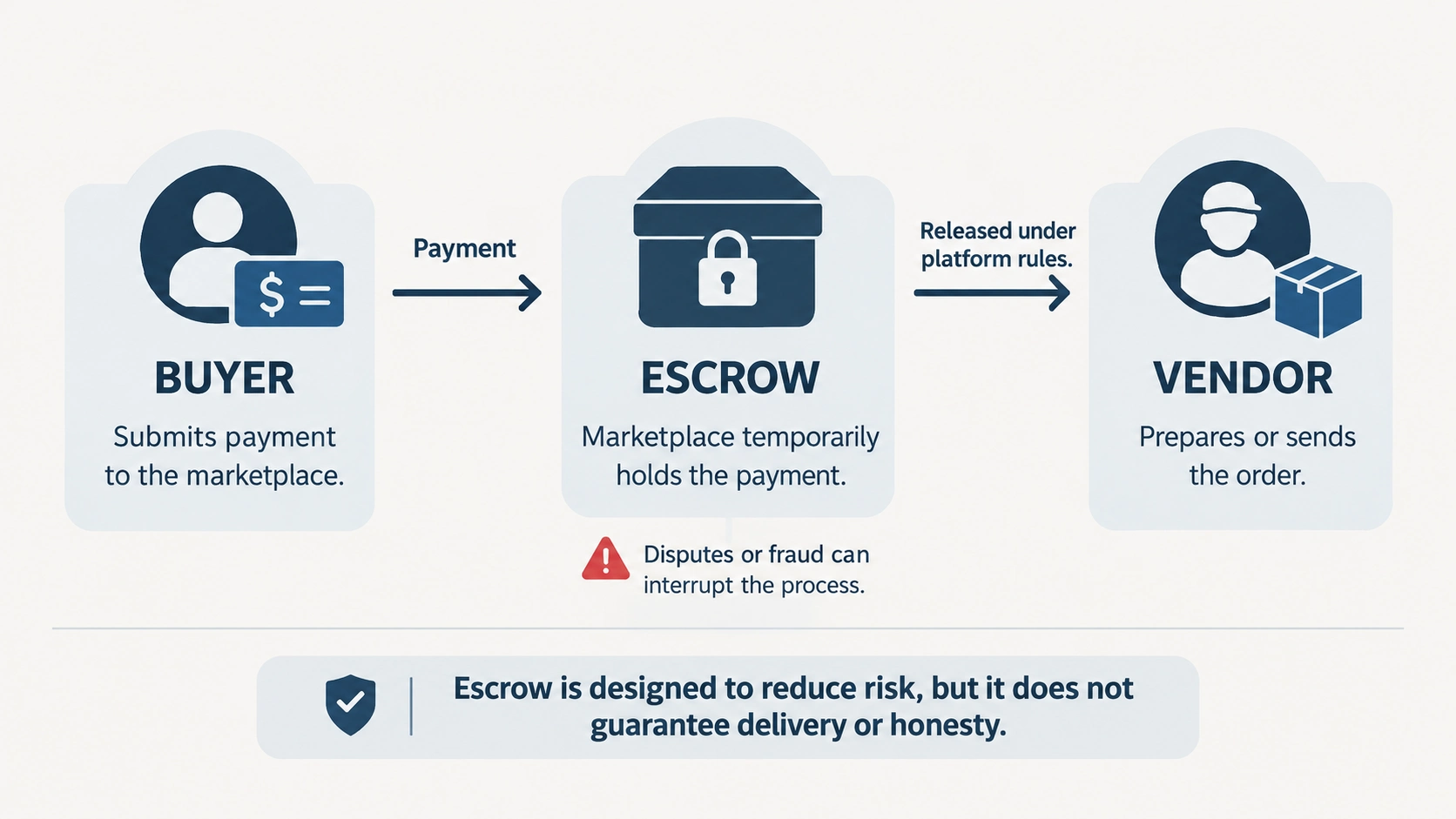
What is the main problem with escrow? The system depends on the people controlling it. If the market owner steals the funds, loses control of the payment system, or disappears, users may have no practical way to recover their money.
Escrow also cannot prove that a seller is honest or that an item is safe. It is a payment arrangement, not a guarantee of quality or legality.
Academic research on trust in cryptomarkets has examined how escrow can affect transactions and relationships between buyers and sellers. Read the study Trust intermediary in a cryptomarket for illegal drugs in the European Sociological Review.
How Do Dark Web Market Reviews and Ratings Work?
Reviews are another way a market tries to build trust. A seller may have a profile showing a rating, past feedback, or comments from earlier transactions.
On a normal shopping website, reviews help customers compare products and service. Dark web markets have used similar systems, even though buyers may not be able to check the seller’s real identity or confirm every claim.
For example, a seller profile might show a high average rating and several positive comments. Other users may see this as a sign that the seller has completed past transactions.
But a rating does not tell the whole story. Some reviews may be fake, copied, paid for, or written by people working with the seller. A seller may also have a good record and later decide to scam customers.
Why can reviews be misleading?
- Fake feedback: Some reviews may not come from real customers.
- Limited history: A seller’s past behaviour cannot prove what they will do next.
- False trust: A high rating can make a risky seller look safe.
- Platform control: Market owners may remove, change, or limit reviews.

Research on darknet marketplaces has found that feedback and reputation systems can shape how users judge sellers. But these systems do not remove the risk of fraud.
The main lesson is simple: a rating is a claim, not proof. This is true on ordinary shopping websites too, but it matters even more when there is little legal protection.
What Are Vendor Bonds on Darknet Markets?
A vendor is a seller. A vendor bond is money or another form of value that a seller must commit to meet a platform’s rules or gain permission to sell there. The exact meaning and conditions can vary between markets.
Think about a rental agreement. A landlord may ask for a deposit to cover certain costs if the agreement is broken. A vendor bond is based on a similar idea: the seller has something at stake.
Some darknet markets have used bonds or seller status systems as a way to discourage dishonest behaviour. The idea is that a seller who risks losing money may have a reason to follow the platform’s rules.
However, a bond is not a background check. It does not prove a seller’s identity, make illegal goods safe, or guarantee that a buyer will receive what was promised.
A dishonest operator may still take the money and disappear. A market can also change its bond rules or shut down without returning funds.
Vendor bonds, ratings, and escrow all try to solve the same basic problem: how can people deal with strangers when there is little trust? Each system has limits, especially when the people running the platform cannot be held accountable through normal legal channels.
How Can Dark Web Markets Create Evidence for Police?
Some people assume that using an anonymous name or an encrypted network makes every action impossible to trace. That is not true.
A marketplace may store account details, private messages, transaction records, seller ratings, order information, or other activity records. Payment services and delivery systems may also create records outside the marketplace.
Investigators may examine these records alongside information from seized computers, financial investigations, witnesses, and other evidence. A single username or transaction does not automatically prove who committed a crime, but several pieces of evidence may help investigators build a case.
For example, when a market’s servers are seized, investigators may gain access to records that were previously controlled by its operators. Those records can provide leads about accounts, transactions, and possible links between people.
The FBI explained this approach in its report on Operation SpecTor. The international operation targeted darknet markets and used evidence from investigations to develop further leads. The FBI reported 288 arrests connected with the operation in May 2023.
In other words, the same systems designed to organise a market can leave records that investigators may later examine. An online rating or payment record might seem like a small detail, but it can become useful when it is linked with other evidence.
For more background, see our dark web timeline, which covers major events in the history of dark web markets.
Why Do Dark Web Markets Fail?
Escrow, reviews, and vendor bonds may create the appearance of trust. But they cannot fix every problem. Several major risks can bring a market to an end or leave users with lost money.
1. Scams and exit scams
A scam happens when someone tricks another person for money or other gain. In an exit scam, the people running a platform or seller operation disappear with funds instead of continuing the service.
This can leave users with no working support team and no clear way to recover their money. Even a market with a long history may fail in this way.
To see how this happens in real life, read the Sheep Marketplace exit scam story from 2013, when a market suddenly disappeared with its users’ Bitcoin. Our guide to dark web exit scams explains three more cases.
2. Hacks and stolen information
Dark web markets still depend on computers, servers, accounts, and software. A security weakness may expose messages, account records, financial information, or other data.
A market that claims to protect privacy can still suffer a data breach. If records are exposed, people who believed they were hidden may face serious risks.
3. Law enforcement takedowns
Police agencies can investigate the people and infrastructure behind a market. A coordinated operation may seize servers, close domains, arrest suspects, and collect records for later investigation.
In June 2025, Europol announced a coordinated operation against Archetyp Market. Authorities reported action across several European countries and the seizure of important evidence. The case shows that even a long-running marketplace can be shut down.
Read the official report: Europol’s Archetyp Market takedown report.
4. Owners cannot always be trusted
A market’s owners may control the website, its rules, and parts of its payment system. Users may have little power if the owners act dishonestly or stop operating.
This is the biggest weakness in the idea of a private trust system. The platform asks people to trust the same people who control the system.
For a closer look at how investigators break up these markets, read 11 major dark web takedowns explained and how police catch dark web criminals.
Real Examples: Silk Road, Hydra, and Market Takedowns
Past cases help explain why market rules are not enough to protect users or keep a platform running.
Silk Road
Silk Road became one of the best-known dark web marketplaces after it appeared in 2011. It used online listings and cryptocurrency payments, and its operation became the subject of a major criminal investigation.
The case showed that an online marketplace could be investigated through its operation, records, and other evidence. It also helped bring public attention to the risks linked to criminal markets.
Want the full story? Read our Silk Road dark web story, or see where it fits in our dark web history timeline.
Hydra
Hydra was a major darknet marketplace that operated mainly in the Russian-speaking world. Researchers studied its use of escrow, feedback, ratings, and dispute handling. The market shut down in April 2022.
The academic paper Hydra: Lessons from the World’s Largest Darknet Market explains how these systems formed part of the market’s structure.
You can read the full story in our guide to the rise and fall of Hydra Market.
These cases show that the systems inside a marketplace can be studied after it closes. They also show why online anonymity should never be treated as a promise that users cannot be identified.
How to Stay Safe Online
You do not need to visit a dark web market to understand its risks. You can protect yourself by following a few basic online safety rules.
- Do not trust a website only because it has positive reviews.
- Never assume that cryptocurrency payments can always be recovered.
- Do not open unknown files or links from untrusted sources.
- Use strong, unique passwords and turn on two-factor authentication.
- Keep your devices and software up to date.
- Be careful about sharing personal details online.
- Report suspected fraud to the proper authorities or service provider.
Thinking about visiting the dark web just to look around? First read Is it safe to go on the dark web? It explains five real dangers in plain words. You can also check our sources and research page to see where our facts come from.
Frequently Asked Questions
How do dark web markets work?
Dark web markets are online platforms where users can view listings and communicate through services designed to provide greater privacy. Some criminal markets have used cryptocurrency, escrow, reviews, and seller rules to manage transactions. These systems do not guarantee safety or honesty.
What is escrow on a dark web market?
Escrow is a payment arrangement in which a third party holds funds until certain conditions are met. On a dark web market, the platform may control the funds and apply its own rules to release payments or handle disputes.
Can dark web market reviews be trusted?
Not always. Reviews may be fake, incomplete, or misleading. A high rating cannot prove that a seller is honest or that a transaction is safe.
What is a vendor bond?
A vendor bond is money or another form of value a seller commits under a platform’s rules. It may be intended to discourage dishonest behaviour, but it does not guarantee that a seller is trustworthy.
Can police investigate dark web markets?
Yes. Investigators may use seized server records, transaction information, account data, financial evidence, and other leads. An anonymous username does not guarantee that a person cannot be identified.
Why do dark web markets shut down?
Markets may close because of scams, hacking, financial problems, disputes among operators, or law enforcement action. When a market disappears, users may lose access to funds or information stored on the platform.
Is escrow a guarantee against scams?
No. Escrow can reduce some payment risks, but it depends on the people and systems controlling it. It cannot guarantee that the seller is honest or that the platform will remain online.
Helpful Sources and Further Reading
This guide uses academic research and official reports to explain how dark web markets operate and how investigators examine them. These links are useful for readers who want to learn more.
- Academic research: Hydra and darknet marketplace systems
- Academic research: Trust and escrow in cryptomarkets
- FBI: Operation SpecTor and darknet market investigations
- Europol: Archetyp Market takedown
- U.S. Department of Justice: Criminal complaint discussing darknet marketplaces and escrow
- DeephidX: Dark web glossary
- DeephidX: Dark web timeline
- DeephidX: Sources and research
The Short Version
So, how do dark web markets work? They have used escrow, reviews, ratings, and vendor bonds to create trust between anonymous users. Escrow can hold money, reviews can show past feedback, and bonds can give sellers a reason to follow platform rules.
But none of these systems guarantees safety. Market owners can disappear, accounts can be fake, data can be stolen, and police can seize platforms and investigate their records.
The main lesson is simple: a system that looks trustworthy is not always safe or reliable. Understanding how these markets work helps explain both their rise and their repeated failures.



Comments