

By Ehtijad Ali
Updated: October 2026
Reading time: about 7 minutes
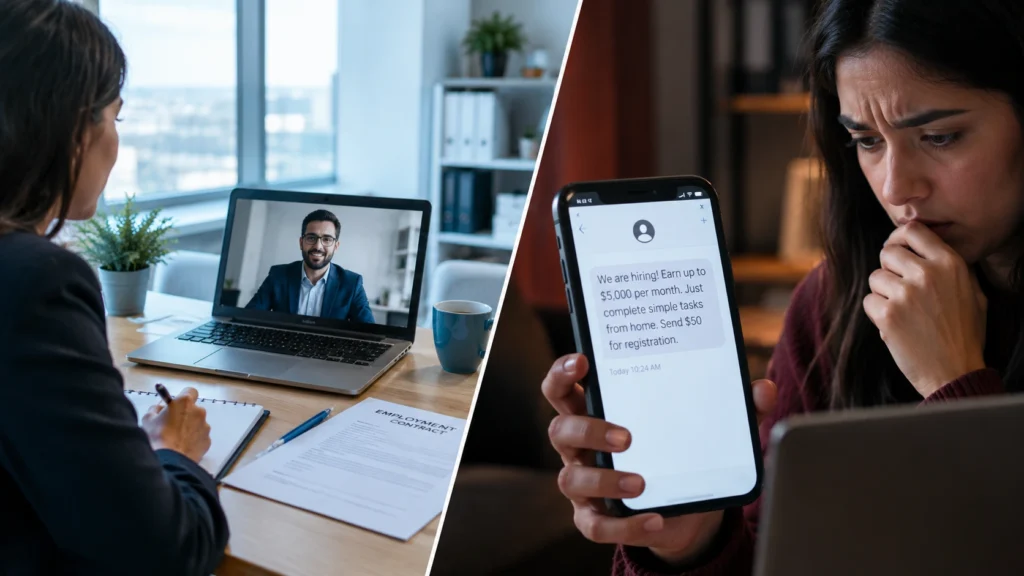
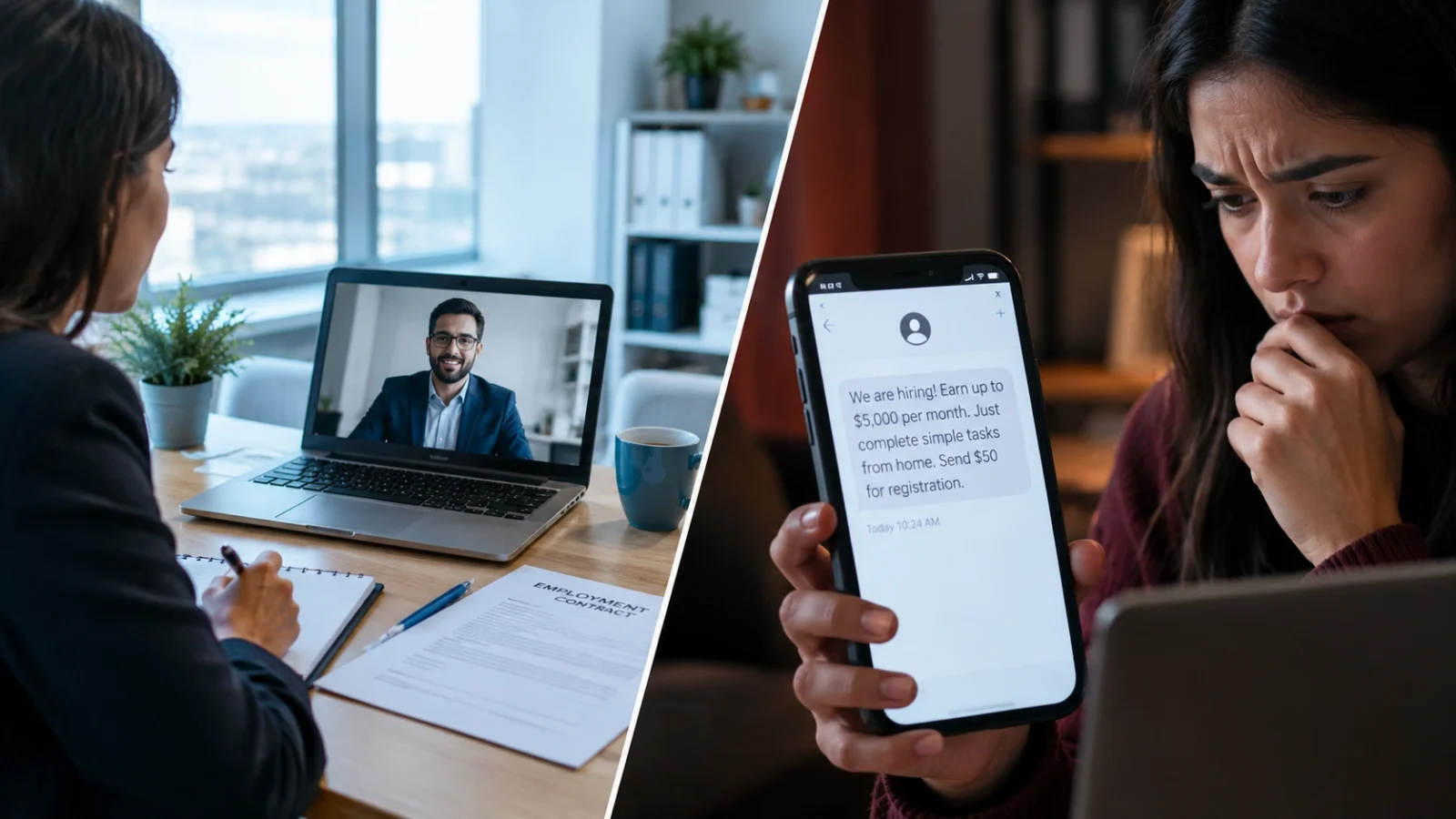
A recruiter messages you on WhatsApp. The role is remote, the pay is generous, and they want you to start this week. There is no proper interview, just a quick chat and a request: pay a small “training fee,” or send a photo of your ID and your bank details “for payroll.”
That is how most fake job offer scams begin. Criminals pose as employers or recruiters, and what they want is your money, your identity documents, or your bank account. This guide shows how the common versions work, the warning signs that give them away, how to check whether a recruiter is real, and what to do if you have already replied.
What You Will Learn
What Is a Fake Job Offer Scam?
A fake job offer scam is a recruitment fraud in which someone pretends to be hiring so they can take something from you. They often borrow a real company’s name, logo, or job ad, and some build convincing websites and email signatures. The “job” exists only to get one of three things:
- Money: fees for training, equipment, visas, or “unlocking” earnings.
- Personal data: ID cards, passports, tax numbers, and selfies that can be used for identity theft.
- Access: your bank account or phone number, which can be used to move stolen money or take over your accounts.
These scams arrive through job boards, LinkedIn, email, text messages, Telegram, and WhatsApp. The pitch changes, but the pattern rarely does: an easy job, fast hiring, and a request that no honest employer would make.
5 Common Types of Fake Job Offers
1. Task scams (“get paid to like, rate, or optimize”)
You are offered simple online work, such as rating products or “boosting” apps, and an app shows your earnings climbing. You may even receive a small real payment to build trust. Then you are told to deposit your own money, usually in cryptocurrency, to unlock the next set of tasks or withdraw your balance. The balance was never real. The FTC’s warning on task scams describes exactly this pattern, and it shares a lot with the slow trust-building of a pig butchering scam.
2. Fake check scams
The “employer” sends you a check to buy equipment or supplies from a vendor they choose. You deposit it, send money to the vendor, and a few days later the check bounces. The bank then asks you to repay the full amount, while the scammer keeps what you sent.
3. Upfront fees for training, equipment, or visas
Real employers pay to hire you. They do not charge you to start. Any request for a training fee, starter kit, certification, background-check fee, or visa processing fee before you have a verified contract is a scam.
4. Fake remote and reshipping jobs
Remote roles are popular, so scammers copy them. Some ask you to receive packages at home, repackage them, and ship them elsewhere. Those goods were usually bought with stolen cards, and the promised paycheck never arrives.
5. Money mule “payment processing” jobs
Some job ads are really recruiting money mules. You are asked to receive funds into your account and forward them, keeping a “commission.” That money is usually stolen, and the person whose account moved it can face frozen accounts or criminal charges. The FBI’s money mule guidance is clear that saying you did not know is often not enough.
9 Warning Signs of a Fake Job Offer
- They contacted you first, about a job you never applied for. Unexpected offers on WhatsApp, Telegram, or text are a common opening.
- The pay is far above normal for little work. High pay for liking posts or “data entry” is bait.
- There is no real interview. You are hired after a text chat, or the interview happens only over messaging apps.
- You are asked to pay something. Fees, deposits, equipment, or crypto “top-ups” all mean the same thing.
- They want sensitive details too early. ID photos, bank logins, or one-time codes before a signed contract.
- The email domain is wrong. A Gmail or Outlook address, or a lookalike domain, instead of the company’s own.
- The offer letter is vague or sloppy. No clear role, manager, address, or contract terms, plus spelling errors.
- They rush you. “Only two places left” or “accept today” pressure is designed to stop you from checking.
- They want to move the conversation. A recruiter who pushes you off a job site and onto a private app is avoiding the platform’s protections.
Many of these signs apply to any suspicious message, not just job offers. Our guide on how to tell if a message is a scam covers the wider set.
Why Fake Recruiters Want Your ID and Bank Details
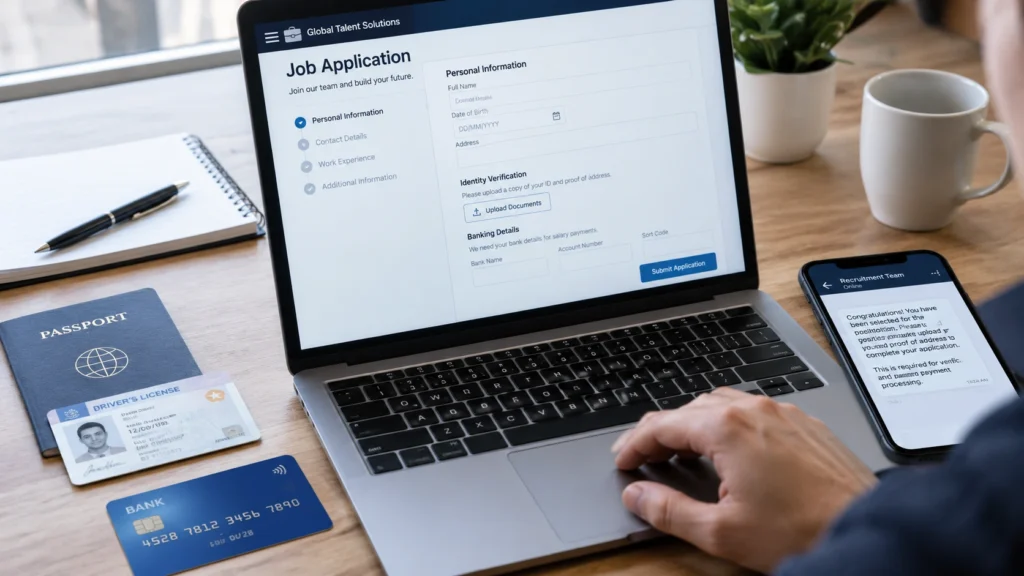
An ID photo, a selfie, and your bank details are enough to open accounts in your name, pass basic identity checks, or apply for loans. Your phone number can be used in a SIM swap scam to intercept security codes. Even when the scam fails, your details may be resold, which is why it helps to understand what criminals do with stolen data.
A real employer does need some of this information, but only after you have a verified offer, usually through a secure HR system, and never your online banking password or a one-time code.
Are WhatsApp and Telegram Job Interviews Real?
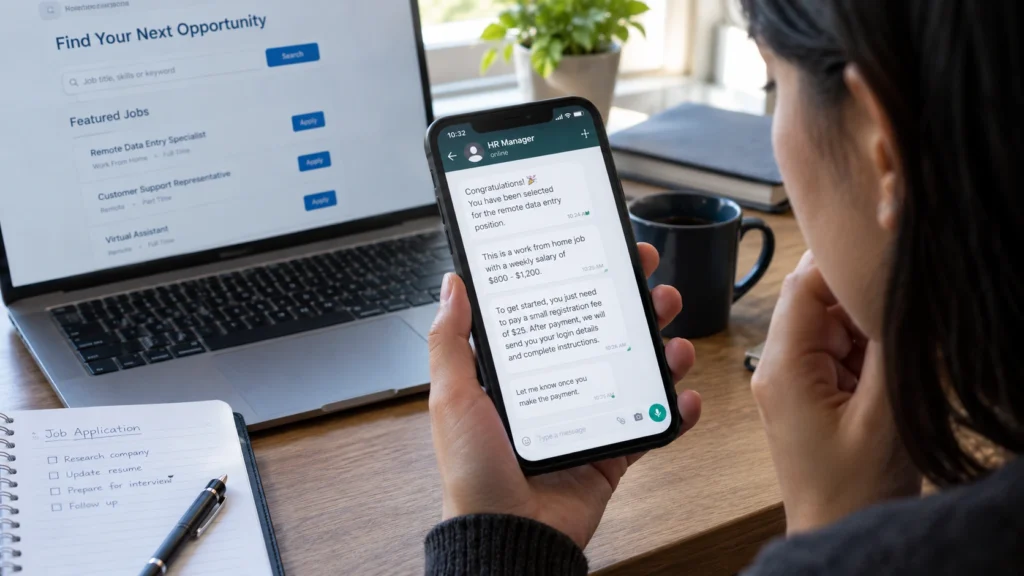
Some small businesses do use WhatsApp to arrange calls. But an interview conducted entirely by text, with no video call, no named hiring manager, and no company email, is a strong sign of fraud. Telegram in particular is widely used to run task scams and recruit mules, as we explain in our article on how Telegram became a hub for cybercrime. The FBI’s IC3 alert on work-from-home scams warns about the same tactics.
How to Check If a Company and Recruiter Are Real
- Find the official website yourself. Search for the company rather than clicking the link you were sent, and check that the site is genuine. Our guide on how to tell if a website is fake walks through the checks, and you can see who owns a website and when its domain was registered.
- Match the job to the official careers page. If the role is not listed there or on the company’s verified LinkedIn page, ask HR directly using contact details from the official site.
- Check the recruiter’s email domain. It should match the company’s domain exactly, with no extra letters or swapped characters.
- Look closely at the recruiter’s profile. New accounts, few connections, stock photos, and a vague work history are warning signs. Many fake profiles now use AI-generated photos, a trend we follow in our AI articles. See how to spot a fake social media account. LinkedIn also publishes advice on recognizing and reporting scams.
- Search for complaints. Try the company or recruiter’s name with words like “scam” or “fraud.” No results does not prove an offer is safe, but reports from others are a clear stop sign. Checking public sources like this is basic OSINT, and anyone can do it.
What to Do If You Already Shared Your Details
Act quickly. The steps below limit the damage.
- Stop replying. Do not send more money or documents, even if they threaten you or promise a refund.
- Call your bank. Use the number on your card. Report the fraud, ask to stop or reverse payments, and watch your statements.
- Secure your accounts. Change any passwords you shared or reused, turn on two-factor authentication, and check if your email appears in a data breach. If you clicked a link from the scammer, read what to do after clicking a phishing link.
- Protect your ID. If you sent ID photos, tell the issuing authority, watch for accounts opened in your name, and consider a credit freeze where available.
- Save evidence and report it. Keep screenshots, phone numbers, and payment receipts. Report the scam to the job platform, your local police or cybercrime unit, and, in the US, to the FTC at ReportFraud.ftc.gov and the FBI at IC3.gov.
Be wary of anyone who contacts you afterwards offering to recover your money for a fee. Recovery scams often target people who have just been defrauded.
Frequently Asked Questions
Do real companies ask for training fees before hiring?
No. Legitimate employers cover the cost of training and equipment. A request to pay before you start is one of the clearest signs of a scam.
Can a real company send a job offer without an interview?
It is very rare. Most genuine offers follow at least one live interview with a named person. An offer that appears after a short text chat should be verified directly with the company’s HR team.
Can a fake recruiter steal my identity?
Yes. With your ID, a selfie, and personal details, a scammer can open accounts or take out loans in your name. Watch your accounts and credit closely if you shared these.
What should I do if I paid money for a fake job?
Contact your bank or payment provider right away to try to stop or reverse the payment, then report the scam and keep all evidence. The FTC’s job scams guide explains how to report it and what to expect.
The Short Version
A real job pays you. A fake one asks you to pay, rushes you, and wants your documents before you have a verified contract. Slow down, confirm the offer through the company’s official channels, and never send money or one-time codes to someone who says they are hiring you. For more plain-English guides to scams, privacy, and online safety, visit the DeepHiDX homepage or browse our cybercrime, cybersecurity, and privacy articles.
Explore More on DeepHiDX
Beyond scams, we cover the dark web and its history, from the Silk Road story and the covert Hansa operation to dark web explainers, Tor Browser guides, and deep web vs dark web. You will also find hacking history, security news, surveillance and censorship, Linux guides, conspiracy theories, and internet mysteries.

Comments