


By Ehtijad Ali
Updated: October 2026
Reading time: about 10 minutes

Before Bitcoin became a common name, another form of digital money was already being used to send payments across the internet. It was called Liberty Reserve.
People could open accounts, send money to other users, and pay websites without using a normal bank transfer for every payment. The service became popular around the world. But it also became linked to online fraud and other crimes.
In May 2013, authorities shut down Liberty Reserve as part of a major international money laundering investigation. US prosecutors said the system had processed more than $6 billion in suspected criminal funds.
So, what was Liberty Reserve, why did criminals use it, and what happened when the service disappeared? This guide explains the full story in simple words, from its early days to the lessons it left for digital money and crypto investigations.
What This Guide Covers
What Was Liberty Reserve?
Liberty Reserve was an online payment service that used its own form of digital money. The company was set up in Costa Rica in 2006. Users could hold a balance in their accounts and send that balance to other users through the website.
Think of it like an online wallet. Instead of handing someone cash, you sent money from your account to theirs. A website that accepted Liberty Reserve payments could also use the system to collect money from customers.
The service used a digital currency often called LR. It offered a way to move money between people in different countries, including people who did not want to use traditional payment services.
Liberty Reserve was not Bitcoin. It was a company-run payment system, and users depended on that company to operate their accounts and process payments. Bitcoin, by comparison, uses a public blockchain and does not depend on one company to run the payment network.
For more background on how digital crime changed over time, visit our dark web timeline.
How Did Liberty Reserve Work?
The basic idea was simple. A user opened an account, obtained digital money through an exchange service, and sent payments to other Liberty Reserve users.
- Open an account. A user created an account on the Liberty Reserve website.
- Add digital money. Users usually relied on outside exchangers to change regular money into Liberty Reserve funds.
- Send a payment. A user could transfer funds to another account or pay a website that accepted LR.
- Exchange the funds again. An exchanger could help turn the digital balance back into regular money.
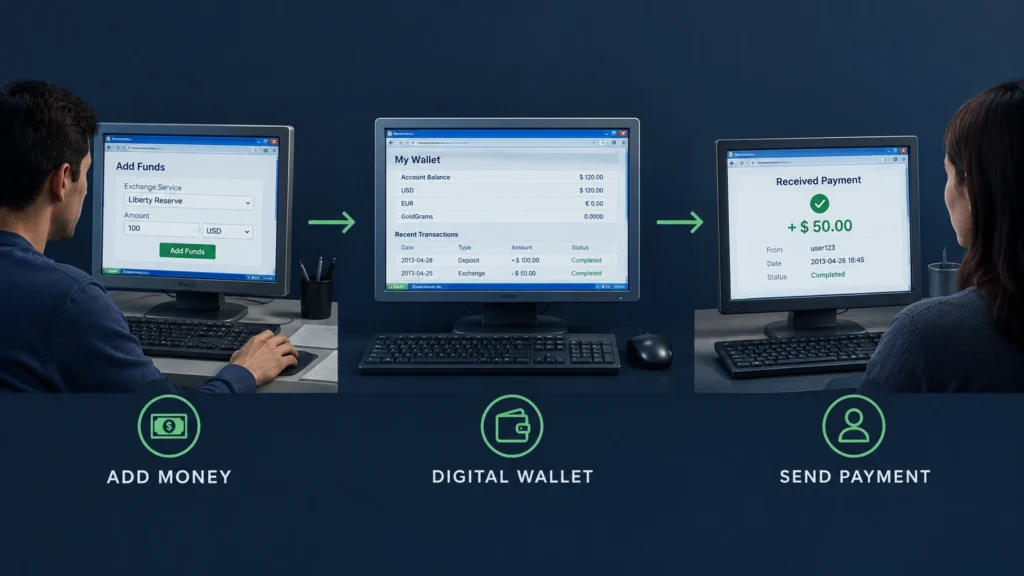
This setup allowed money to move across borders through several accounts and services. It also meant that the company did not handle every deposit or withdrawal directly through a bank.
According to the US Department of Justice, Liberty Reserve did not require users to verify their identities in the way regulated financial services generally do. Investigators said people could use false names and that the system made it easier to hide who was behind some transactions.
That lack of strong identity checks was a major problem. A payment service can be useful to ordinary people, but it can also attract criminals when users can move money without proper checks.
Why Did Criminals Use Liberty Reserve?
Not every person who used a digital payment service was involved in crime. However, investigators said Liberty Reserve became popular among criminals because it helped them move money while hiding their real identities.
US prosecutors linked the service to money from several types of crime, including credit card fraud, identity theft, online investment scams, computer hacking, and drug trafficking.
1. Users could hide their identities
Investigators said users could create accounts with false names. This made it harder to know who controlled an account just by looking at its details. Criminals often build fake identities from personal details stolen online, which is one reason to check the most important privacy settings on your own accounts.
2. Money could pass through different services
Outside exchangers helped users move between regular money and Liberty Reserve funds. Investigators said these services could make it harder to follow the full path of a payment, especially when several accounts and countries were involved.
3. Online criminals could receive payments
Some websites connected to fraud and other illegal activity accepted Liberty Reserve payments. This gave criminals a way to receive and move money from online crimes. Many of these crimes began with fake emails or texts, so it helps to know how to tell if a message is a scam.
The important lesson is that digital money itself is not the problem. The bigger risks come from how a payment system is run, how users are checked, and whether suspicious activity is reported.
The 2013 Liberty Reserve Shutdown
The major action against Liberty Reserve became public on May 28, 2013. The US Department of Justice announced charges against the company and seven of its principals and employees. The announcement followed arrests made on May 24 in several countries.
Authorities from 17 countries took part in the wider investigation and enforcement action. Investigators seized websites and took steps against bank accounts and other assets linked to the case.
The US Treasury also named Liberty Reserve as a financial institution of primary money laundering concern under Section 311 of the USA PATRIOT Act. It was the first time the Treasury used this authority against a virtual currency provider.
When the service was shut down, users could no longer rely on it to make payments as before. The action also sent a clear message: an online payment service could face serious legal action if authorities believed it was helping criminals move illegal funds.
You can read the original announcements here:
- US Department of Justice: 2013 Liberty Reserve charges
- US Treasury: Liberty Reserve money laundering action
What Did the $6 Billion Figure Mean?
One of the most widely reported parts of the Liberty Reserve case was the figure of more than $6 billion.
In its May 2013 announcement, the US Department of Justice said Liberty Reserve had processed about 55 million transactions involving more than $6 billion in suspected criminal proceeds. Prosecutors also described more than one million users worldwide in the case, including users in the United States.
These numbers showed the reported scale of the investigation. They should be read carefully, though. The $6 billion figure in the original announcement referred to alleged or suspected criminal proceeds, not a finding that every dollar processed by the service came from crime.
That difference matters. A large payment system can process both lawful and unlawful payments. Investigators must examine records and evidence to work out which transactions are linked to criminal activity.
The case also showed how online financial crime can cross borders. A user, a payment service, an exchanger, and a bank account may all be in different countries. Investigating the money can require cooperation between many agencies.
What Happened to the Liberty Reserve Founder?
Arthur Budovsky, Liberty Reserve’s founder, later pleaded guilty to conspiring to commit money laundering. The US Department of Justice announced his guilty plea on January 29, 2016.
According to that announcement, Budovsky admitted to laundering more than $250 million in criminal proceeds through his operation of Liberty Reserve. This was a separate figure tied to his guilty plea, so it should not be confused with the wider $6 billion figure cited in the original 2013 case.
The case continued after the service itself had disappeared. Investigators and prosecutors used records, financial information, and cooperation across countries to build cases against people linked to the operation.
Read the official record here: Liberty Reserve founder pleads guilty — US Department of Justice.
Liberty Reserve and the Rise of Bitcoin
Liberty Reserve was shut down in 2013, when Bitcoin was still much less widely used than it is today. Both stories are part of the history of digital money, but the systems worked in different ways.
Liberty Reserve depended on a company that controlled its payment system. Bitcoin uses a public blockchain, which records transactions that can be viewed by anyone. Bitcoin addresses do not automatically show a person’s real name, but the payment history can still provide clues.
This is why it is wrong to assume that Bitcoin payments are always secret or impossible to trace. Investigators can study blockchain records and, when they find other evidence that connects an address to a person or service, they may be able to follow the money.
Liberty Reserve did not create today’s cryptocurrency investigation methods, and it was not the same as Bitcoin. However, the case showed why financial records, account checks, and international cooperation matter when digital payments are used for crime.
For another example of how investigators and users have followed digital payments, read our article on the Sheep Marketplace exit scam and the 2013 Bitcoin theft.
What the Liberty Reserve Case Taught Law Enforcement
The Liberty Reserve case showed that an online payment service could not avoid investigation simply because it operated on the internet or served users in many countries.

- Digital payments leave clues. Account records, transfers, bank details, and other evidence can help investigators follow money.
- Identity checks matter. Weak checks can make it easier for criminals to open accounts under false names.
- Countries need to work together. A financial investigation may involve people, servers, and accounts in several places.
- Digital money is not above the law. Companies and people can face action when evidence links them to financial crime.
- New payment tools bring new risks. Investigators must understand how each system works instead of treating every digital currency as the same.
The case also connects to the wider problem of money laundering. Criminals may try to move stolen funds through other people, companies, or payment services to hide where the money came from. Learn more in our guide to what a money mule is and how these scams work.
Questions People Ask
Was Liberty Reserve the same as Bitcoin?
No. Liberty Reserve was run by a company, while Bitcoin uses a public blockchain maintained by a network. Both are part of digital money history, but their designs and records are different.
Can cryptocurrency transactions be traced today?
Some cryptocurrency transactions can be traced by studying public blockchain records and matching them with other evidence. The result depends on the currency, the services involved, and the information available to investigators. Read more in our guide on whether Bitcoin can be traced.
Helpful Links and Sources
These sources provide original information about the Liberty Reserve case and related digital money investigations.
- US Department of Justice — 2013 charges and investigation
- US Department of the Treasury — Liberty Reserve action
- US Department of Justice — Founder guilty plea
- FinCEN — Financial records in the Liberty Reserve investigation
- DeepHidX — Dark web timeline
- DeepHidX — Sheep Marketplace and Bitcoin
- DeepHidX — What is a money mule?
- DeepHidX — How to tell if a message is a scam
- DeepHidX — The most important privacy settings
- DeepHidX — Sources and research
- DeepHiDX: Can Bitcoin Be Traced?
- DeepHiDX: Dark Web Takedowns
- DeepHiDX: Deep Web vs Dark Web




Comments