

By Ehtijad Ali
Updated: September 2026
Reading time: about 9 minutes

People use the words deep web and dark web like they mean the same thing. They do not.
Your email inbox is part of the deep web. Your bank account page is too. So is your school portal. These are normal things you use every week.
The dark web is something else. It is a small corner of the internet that you can only reach with a special tool.
This guide explains deep web vs dark web in plain words. No tech talk. No scary music. Just the difference, with everyday examples.
What is in this guide?
Deep web vs dark web: the short answer
Here is the whole thing in two lines.
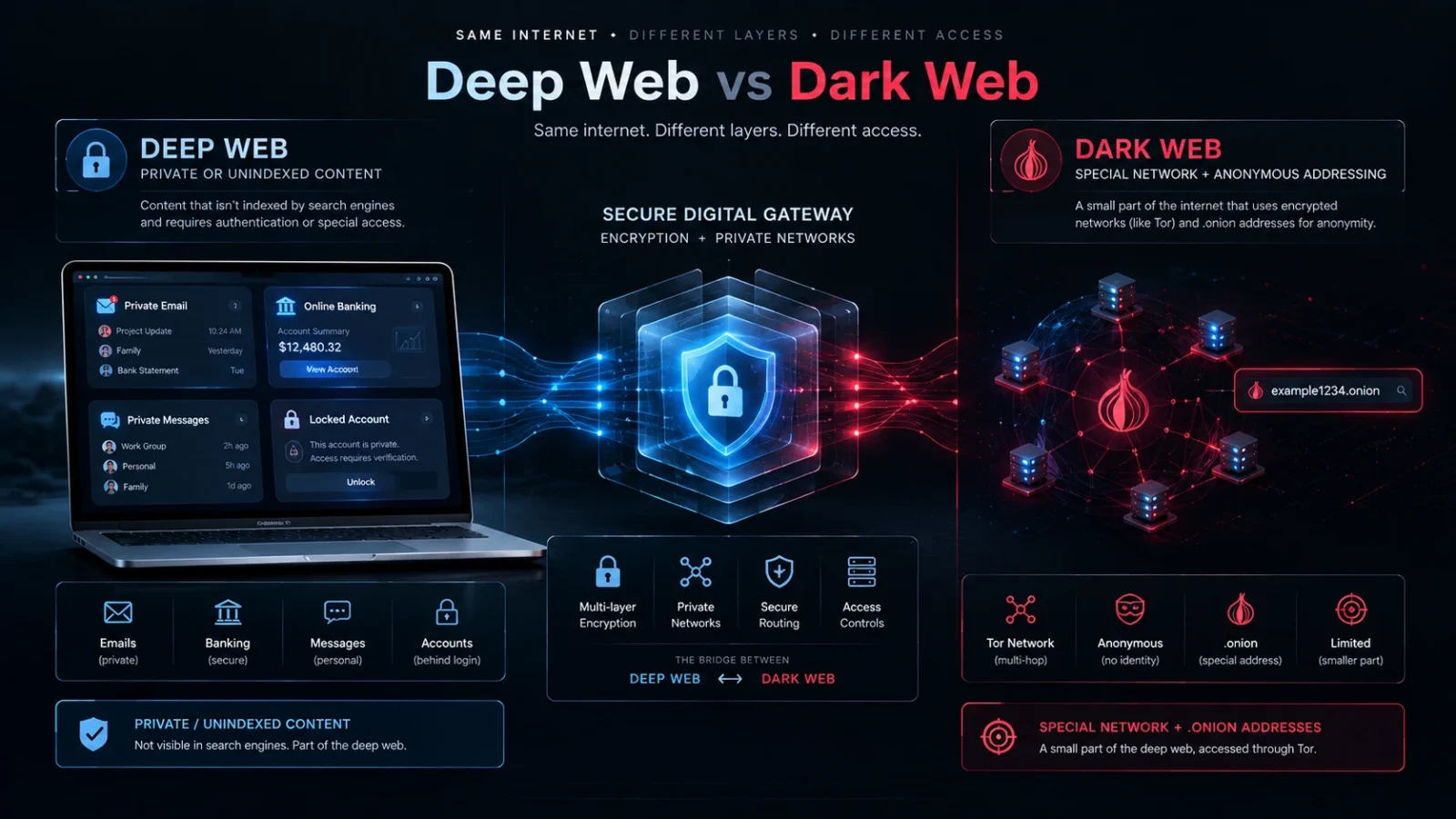
- Deep web = pages that Google cannot show you. Usually because you need to log in first.
- Dark web = a tiny part of the internet that needs a special browser, like Tor.
That is the deep web vs dark web difference. One is about logins. The other is about how you get there.
The dark web is a small part of the deep web. It is not a separate internet.
The three layers of the internet
Almost every mix-up about deep web vs dark web comes from picturing two layers instead of three. So let us draw all three.

Think of the internet like an ocean.
- The surface web is the top. Anyone can see it. Google can find it. News sites, shops and blogs live here.
- The deep web is everything under the surface. It is huge. Your inbox, your grades, your bank page.
- The dark web is a small cave near the bottom. You need a special key to open the door.
Most people only ever swim at the top. That is fine. But you use the deep web every day without noticing.
When people argue about deep web vs dark web, they usually forget the middle layer. The middle layer is the biggest one by far.
What is the deep web?
The deep web is any page a search engine cannot list.
That sounds spooky. It is not. Here are real examples:
- Your private email inbox
- Your online banking page
- Your photos in cloud storage
- Your school or college portal
- A company tool that staff log into
- A library database you pay for
See the pattern? Almost all of it sits behind a login box.
Google is not blocked by a villain. Google just does not have your password. That is the whole secret.
So in the deep web vs dark web question, the deep web is the boring, useful, everyday part. And it is most of the internet.
Why your email is part of the deep web
This is the easiest way to see deep web vs dark web clearly.
Search Google for your own email address. You may find an old profile. You may find a comment you left.
But Google cannot show your messages. It cannot read your drafts. It cannot open your spam folder.
Why not? Because your inbox needs your password. No password, no pages.
Your inbox is deep web content. It is private, not hidden in a scary way.
Worth knowing: if a company you use gets hacked, your login can leak. You can check if your email was in a data breach in about a minute. That is a real risk. The dark web is not.
What is the dark web?

The dark web is a small part of the internet built on top of special networks.
The best known one is Tor. Tor sends your traffic through several computers around the world. Each step hides a little more about you. Wondering how Tor compares to a VPN? Read our Tor vs VPN guide.
Dark web sites do not end in .com or .org. They end in .onion. And a normal browser cannot open them at all.
You can read how this works in the Tor Project guide to .onion services.
So the second half of deep web vs dark web is about the road, not the lock. You need a different road to get there.
Curious about what you would actually find at the end of that road? Our easy guide on what is on the dark web explains the good parts, the bad parts, and the myths.
What makes a site part of the dark web?
Lots of simple articles get this bit wrong. So here is the rule.
Missing from Google does not mean dark web.
Your inbox is missing from Google. A company dashboard is missing from Google. A paid research database is missing from Google. None of those are dark web.
A site is dark web only when it lives on an anonymity network like Tor and uses a special address.
That single rule settles most deep web vs dark web arguments. Ask one question: do I need Tor to open it?
Deep web vs dark web: 7 simple differences
Here are the seven things that actually tell them apart.
- The door. Deep web needs a login. Dark web needs a special browser.
- The browser. Deep web works in Chrome or Safari. Dark web needs Tor.
- The address. Deep web uses normal ones like .com. Dark web uses .onion.
- The size. Deep web is most of the internet. Dark web is a tiny slice.
- Who is behind it. Deep web sites usually know exactly who you are. Dark web sites are built so nobody does.
- How normal it is. You use the deep web daily. Most people never touch the dark web.
- Why it is hidden. Deep web is private for practical reasons. Dark web is private on purpose, by design.
Learn those seven and the deep web vs dark web mix-up stops for good.
A quick example you can remember
Try sorting these in your head:
- Your Gmail inbox → deep web
- Your bank dashboard → deep web
- Your school report card online → deep web
- A private company database → deep web
- A .onion site you open in Tor → dark web
Four out of five are deep web. That is the deep web vs dark web balance in real life.
How big is the deep web vs dark web?
Size is where most of the myths come from, so it is worth slowing down here.
You will see wild numbers online. Be careful with them.
Nobody can count the whole internet. There is no live counter. Pages appear and vanish every second.
What experts do agree on is the shape. The deep web is far bigger than the surface web. The dark web is small compared to both.
One large study of onion services found only a few thousand active sites at a time. Compare that to billions of normal web pages.
So when someone quotes a huge scary number for deep web vs dark web, ask which one they mean. Usually they mean the deep web, and the deep web is mostly your email.
Why the news mixes deep web vs dark web up
Headlines need short words. “Dark web” sounds more exciting than “a private server”.
So a leak from a company database gets called a dark web story. Often it was just a normal hacked website.
Here is the honest version. Stolen data is often sold on dark web markets later. But the theft itself usually happens on the ordinary web.
Mixing up deep web vs dark web makes normal things sound dangerous. It also makes real risks harder to spot.
What the deep web does for you every day
It is easy to forget how much of your normal day happens in the deep web.
You wake up and check your messages. Deep web. You look at your bank balance on the bus. Deep web. You open a shared folder at work. Deep web again.
None of those pages can be found by searching. They are made just for you, after you prove who you are.
This is why the deep web is so large. Every person has their own private copy of many pages. One shop might have a public product page and a million private order pages.
That is the part most people miss in the deep web vs dark web story. The deep web is not one hidden place. It is millions of small private rooms.
How do people reach the dark web?
You do not need to try this. But it helps to know how it works.
People download the Tor Browser. It looks a lot like Firefox. When they type a .onion address, Tor passes the request through three different computers before it arrives.
Each computer only knows the step before and the step after. No single one knows both who you are and where you are going.
That is the whole trick. It is slow, and it is meant to be.
Normal browsers cannot do this. That is the clearest line in deep web vs dark web: a password gets you into the deep web, but only a different network gets you into the dark web.
If a word in this guide is new to you, our dark web glossary explains it simply.
Four myths about deep web vs dark web
Myth 1: the deep web is a secret place
It is not a place at all. It is just every page that needs a login. Your own inbox is part of it.
Myth 2: the dark web is huge
It is small. Studies count a few thousand live sites at a time. The normal web has billions of pages.
Myth 3: you can wander onto the dark web by accident
You cannot. A normal browser will not open a .onion address. You have to go and get a special browser first.
Myth 4: deep web and dark web mean the same thing
This is the big one. They are not the same. The dark web is a small part of the deep web, not a twin of it.
Most bad advice online starts with one of these four myths. Once you can spot them, deep web vs dark web headlines get much easier to judge. Our dark web timeline shows how the real story grew.
Is any of this dangerous?
Short answer: not in the way films make you think. Let us split it properly.
The deep web is not dangerous. It is your own private stuff.
The dark web is a tool. Tools are not good or bad on their own. Journalists and researchers use Tor. So do criminals.
The real danger for most people is much more ordinary:
- Using the same password on many sites
- Clicking a link in a scary email
- Never turning on two-step login
Those cause far more harm than the dark web ever will. Fixing them takes ten minutes. Start by checking if your email was in a data breach.
It also helps to know how much you give away on any normal site. Our guide to what information your browser shares explains it in the same plain style.
What if your data ends up on the dark web?
This is the one part of deep web vs dark web that can touch your real life.
When a company is hacked, the stolen list often gets sold. Some of those sales happen on dark web markets. Your email and old password can sit in a file with millions of others.
That sounds frightening. The fix is boring and it works:
- Check whether your email has appeared in a known leak. It takes a minute.
- Change the password on any site that was hacked.
- Change it anywhere else you used the same one. This is the step people skip.
- Turn on two-step login for your email and your bank.
- Ignore any message that pushes you to click fast.
You do not need Tor for any of this. You never have to visit the dark web to protect yourself from it.
Our guide on how to check if your email was in a data breach walks through each step with pictures.
Two sentences to remember
If you forget everything else, keep these:
- Deep web: pages search engines cannot list, usually because you need to log in.
- Dark web: a small part of the deep web that needs a special network like Tor.
That is deep web vs dark web, finished. Everything else is detail.
Questions people ask
These are the questions readers send us most often about deep web vs dark web.
Is Gmail part of the deep web?
Yes. Your inbox needs your password, so Google cannot list your messages in search. That makes it deep web content. It is a perfect example in any deep web vs dark web explainer.
Is the deep web illegal?
No. The deep web is email, banking, school systems and work tools. Using it is completely normal and legal.
Is the dark web the same as the deep web?
No. The dark web is a small part of the deep web. All dark web sites are deep web. Almost no deep web sites are dark web. That one sentence solves most deep web vs dark web confusion.
Does the dark web only use Tor?
Tor is the best known network, but not the only one. I2P and Freenet work in similar ways. Tor is simply the one most people have heard of. You can read how onion services work on the Tor Project site.
Can Google search the dark web?
No. Normal search engines cannot reach .onion addresses. Some special search tools index parts of it, but they are far from complete.
Is every dark web website dangerous?
No. Some are news sites, libraries and privacy tools. Some are criminal. The safe advice for most people is simple: you do not need to go there.
Why do people confuse deep web vs dark web?
Because both words mean “not in Google”. The deep web is hidden by a password. The dark web is hidden by a network. Same result, very different reason.
Helpful links
These are the sources and guides behind this deep web vs dark web explainer. You can see how we check our facts on our sources and research page.
- DeepHiDX dark web glossary – plain meanings for the words in this guide
- DeepHiDX dark web timeline – how the dark web actually grew
- Check if your email was in a data breach – a five minute safety check
- What information does my browser share? – what normal sites already see
- I2P vs Tor vs Freenet – how three dark web privacy networks really differ
- Is my phone listening to me? – why ads feel personal and how to check your microphone
- AI voice cloning scam – how to spot a fake family emergency call
- SIM swap scam – what to do if your phone suddenly has no service
- Chronolocation – how to tell when a photo was taken
- Tor Project: what are .onion services?
- Tor Project: how do onion services work?
- Dizzy: large-scale crawling and analysis of onion services
- Onion under Microscope (World Wide Web journal)
The short version
Here is everything above, squeezed into a few lines you can repeat to a friend.
Deep web vs dark web is not a hard idea once the words are clear.
The deep web is behind a login. You are in it right now if you have an inbox open.
The dark web is behind a special network. You need Tor, and you almost certainly do not need to go.
One is your daily life. The other is a small, quiet corner. Knowing the deep web vs dark web difference is enough to read any news story without being scared by it.



Comments