

By Ehtijad Ali · Updated October 2026 · About 7 minutes to read
An onion address is the web address of a site on the Tor network. It looks like a long jumble of letters and numbers that ends in .onion. That jumble is not random. It is a kind of digital ID card for the site.
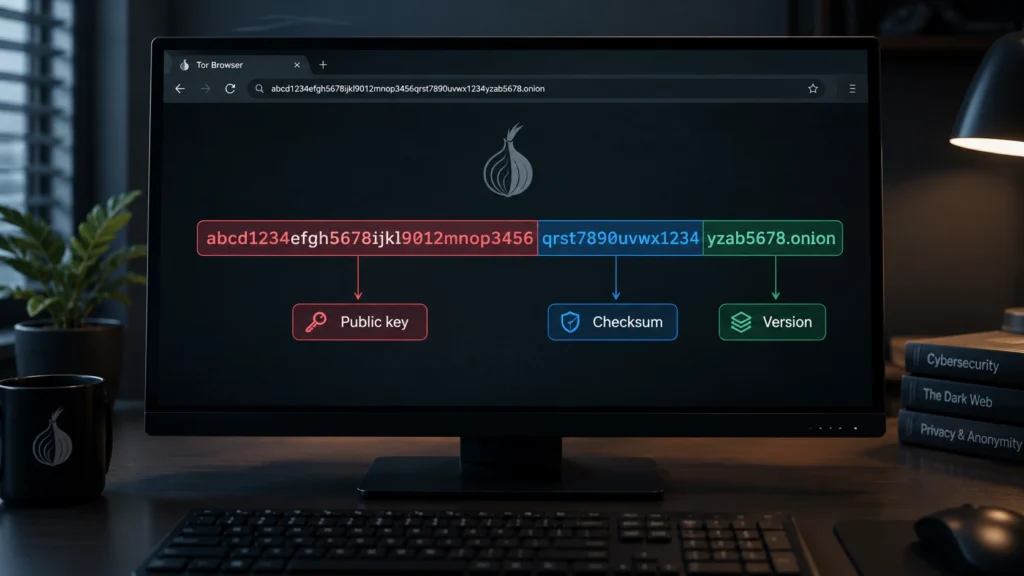
A normal website has a name you can remember, like example.com. An onion site is different. Its address can look like this:
exampleonionaddressforlearningonlyabcdefghijkmnpqrstuvwd.onionThis example is fake. It is only here so you can see the shape. Please do not try to visit it.
In this easy guide, you will learn how onion addresses work, why they are exactly 56 characters long, what changed from old addresses to new ones, and how to spot a fake one.
What is in this guide
What is an onion address?
Think of the internet like a big city. A normal website is a shop with its name on a sign. Anyone can see where it is.
An onion service is more like a secret shop. You can still visit it, but nobody can see where the building really is. You can only reach it with the Tor network, often by using Tor Browser.
The onion address is how you find that secret shop. Nobody picks it like a normal name. Instead, it is made from the site’s secret math keys. That is why it looks so strange.
If you are new to Tor, our guide on Tor vs VPN and which one is better for privacy explains how Tor hides where you are. And if you are wondering whether using Tor is even allowed, read is Tor illegal? what the law says by country.
Want to know what kinds of websites use these addresses? Read our simple guide on what is on the dark web to see the real mix of news sites, privacy tools, scams, and crime.
Why is an onion address 56 characters long?
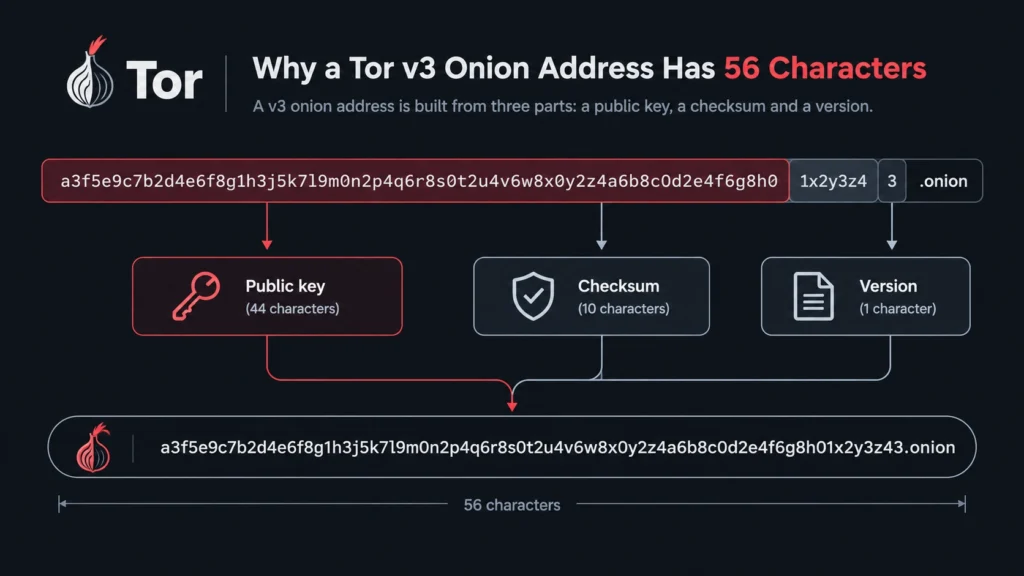
Here is the big rule to remember: a modern onion address has 56 characters before .onion. Not 55. Not 57. Always 56.
Why that number? Because the address is built from three pieces of data, packed together like items in a lunch box:
- Public key (32 bytes): the site’s ID. This is the biggest part.
- Checksum (2 bytes): a tiny safety check that catches typing mistakes.
- Version (1 byte): a number that says which address style this is. For today’s addresses, it is version 3.
Add them up and you get 35 bytes. A computer then turns those bytes into letters and numbers using a system called Base32. Base32 uses 5 bits of data for each character. 35 bytes is 280 bits, and 280 ÷ 5 = 56 characters. That is where the number comes from.
The Tor Project explains this exact recipe in its official onion address format specification.
What do the letters and numbers mean?
Look closely at a real address and you will notice two fun facts.
Fact 1: Only some characters are allowed. Base32 uses the letters a to z and only the numbers 2, 3, 4, 5, 6 and 7. You will never see 0, 1, 8 or 9 in a real one. This rule comes from a common internet standard called RFC 4648.
Fact 2: Real ones end with the letter d. The last character holds part of the version number. Because the version is always 3, every modern onion address ends in d right before .onion.
Here is how the 56 characters are shared out:
- About the first 52 characters come from the public key.
- The last few characters hold the checksum and the version.
So the long address is not just a name. It is part of the safety system.
How the public key protects you
This is the most important part of how onion addresses work.
Every onion site has two matching keys, like a lock and its key:
- A private key that the site keeps secret.
- A public key that anyone can see. It is hidden inside the address.
When you visit an onion site, Tor checks that the site really owns the private key that matches the public key in the address. If the keys do not match, the connection fails.
This means nobody can copy the address and use it for a different site. To do that, they would need the secret private key. That is why the long address is so useful. The Tor Project describes this in its guide How do onion services work?.
V2 vs v3 onion addresses
You might find old guides online that say onion addresses have 16 characters. Those guides are out of date.
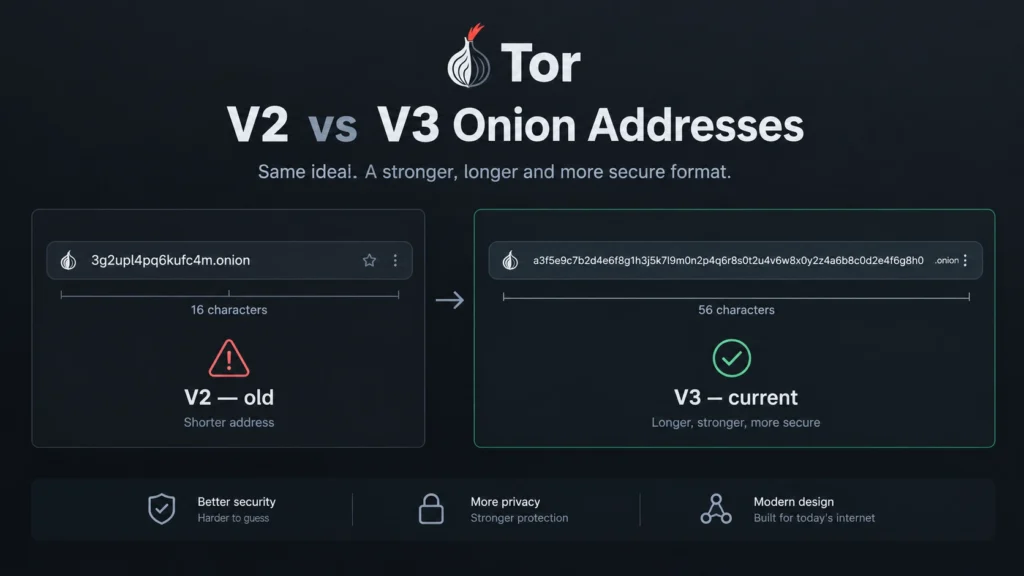
- V2 (old): 16 characters before .onion. These used weaker security.
- V3 (current): 56 characters before .onion. These use stronger, modern security.
Tor stopped supporting v2 addresses in 2021, as shown in the Tor Project’s onion services timeline. Today, only v3 addresses work. To learn more about how Tor and the dark web grew over the years, see our Dark Web Timeline.
Why a short onion address is a warning sign
Here is a simple safety rule: if an onion address is short, stop and check.
A short address today is probably one of these:
- An old v2 address that no longer works.
- A made-up address.
- A fake address used to trick people.
Not every short address was a scam in the past. But today, a short address simply cannot work on Tor.
Can an onion address spell a word?
Yes, sort of. Some sites have addresses that start with their name. These are called vanity onion addresses.
To make one, a computer creates millions of keys until it finds one whose address starts with the right letters. It is a bit like rolling dice over and over until you get the numbers you want.
But the full address is still 56 characters long. Only the start looks friendly.
There is also a risk. A fake site can make an address that starts with the same word as the real one. If you only look at the first few letters, you could be fooled. The Tor Project warns about this in its page on vanity onion addresses. So always check the whole address.
How to check an onion address safely
Knowing how onion addresses work is great. Knowing how to check one is even better. Use this simple checklist:
- Count the characters. There should be exactly 56 before .onion.
- Look at the last character before .onion. It should be the letter d.
- Make sure there is no 0, 1, 8 or 9 in it.
- Compare the whole address, not just the first few letters.
- Get the address from the site’s own official page or a source you already trust.
- Do not trust an address just because it appears in a random online list.
Tor Browser also checks the address for you. If even one character is wrong, the checksum will not match and the page will not load. The Tor Browser Manual explains more, and the EFF’s beginner guide How to: Use Tor shows how to stay safe while using it.
Why we do not link to Hidden Wiki pages
You may see sites called “Hidden Wiki” that list lots of onion links. We do not link to them.
The reason is simple: a list is not proof. A list can be old, copied, changed, or fake. Some lists also point to dangerous or illegal sites.
A better way is to use an address that the organization shares on its own normal website. Our Sources and Research page explains why we do not trust dark web link lists, and our Editorial Policy shows how we check our facts. Curious about the difference between the hidden parts of the internet? Read deep web vs dark web.
Questions people ask
Why is an onion address so long?
A modern onion address is 56 characters long because it holds the site’s public key, a checksum, and a version number. These are turned into letters and numbers with Base32. The long length is part of the safety design.
Are all short onion addresses fake?
Old v2 addresses were short, with 16 characters, but they stopped working in 2021. Today, a short address cannot be a working modern onion address, so treat it with care.
Why does every v3 onion address end in d?
The last character holds part of the version number. Because the version is always 3, it turns into the letter d after Base32 encoding.
Can an onion address be easy to remember?
The start can be. A vanity onion address can begin with a chosen word, but the full address still has 56 characters before .onion.
Is the onion address the same as a public key?
Not exactly. It is built mostly from the public key, plus a small checksum and a version number.
Can someone make up an onion address?
Anyone can type letters that look like an onion address. But a working one must follow the right format and match a real private key. Tor checks this before it connects.
The short version
So, how do onion addresses work? A modern onion address has 56 characters before .onion. It is made from the site’s public key, a checksum, and a version number, all turned into letters and numbers with Base32.
The address is like an ID card. It helps Tor make sure you reach the real site. Old 16-character v2 addresses no longer work. And a friendly-looking start does not prove an address is real.
Most of all, never trust an address just because someone posted it in a list. Always compare the full address with a source you trust.




Comments