

By Ehtijad Ali
Updated: October 2026
Reading time: about 12 minutes

A company gets hacked. Your email and password are in the file.
Then what? Does somebody read it? Does it just sit there?
Neither. It goes on a journey, and that journey is surprisingly organised.
So what do hackers do with stolen data? They run it through a business.
This guide follows the whole trip in plain words. You will see exactly what do hackers do with stolen data, from the break-in to the moment somebody tries to spend your money.
The pattern here matches what investigators report in the Verizon Data Breach Investigations Report and what the FBI’s complaint centre sees every year. No guessing.
What is in this guide?
What do hackers do with stolen data, in one minute
If you only have a minute, here it is.
- They steal a database from a company that was not protecting it well.
- They clean it up and turn it into a tidy list of emails and passwords.
- They sell it, often in bulk, often cheaply, often many times over.
- Buyers test the passwords on banks, shops and email accounts.
- Working logins get used or resold at a much higher price.
- The leftovers feed spam, phishing and scam calls for years.
Nobody sits reading your emails. It is a production line.
Now let us walk each stage slowly.
Where stolen data comes from
Almost none of it is stolen from you directly. It is stolen from companies that hold your details.
- Big breaches. One weak server, and millions of records walk out at once.
- Phishing. One staff member types a password into a fake login page.
- Infostealer malware. A virus on a home computer quietly copies every saved password.
- Weak suppliers. A small partner is hacked, and their access opens a bigger door.
So the honest answer to what do hackers do with stolen data starts earlier than most people think. Long before anyone touches your account, somebody else lost the file.
Which stolen data is actually dangerous?
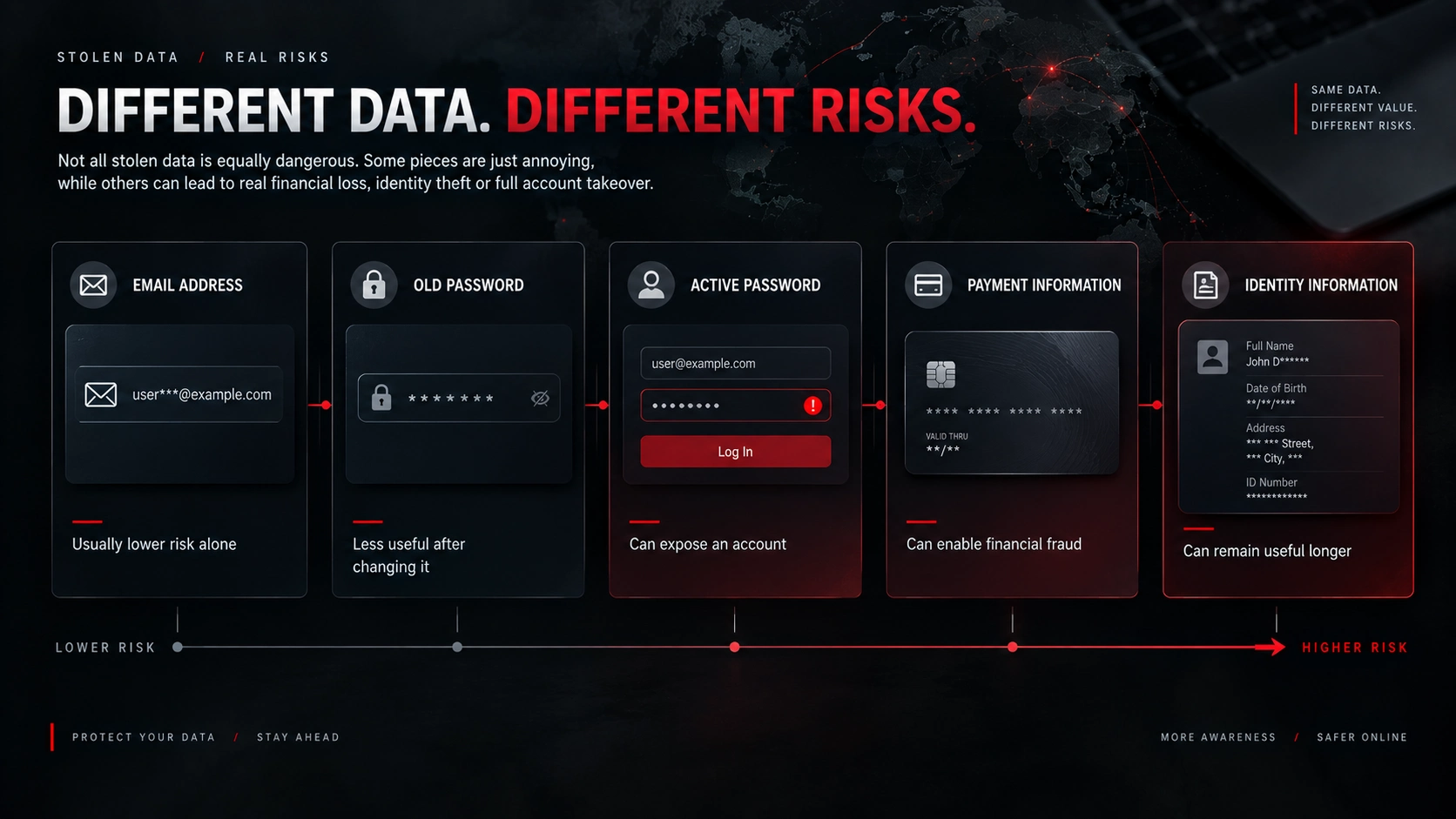
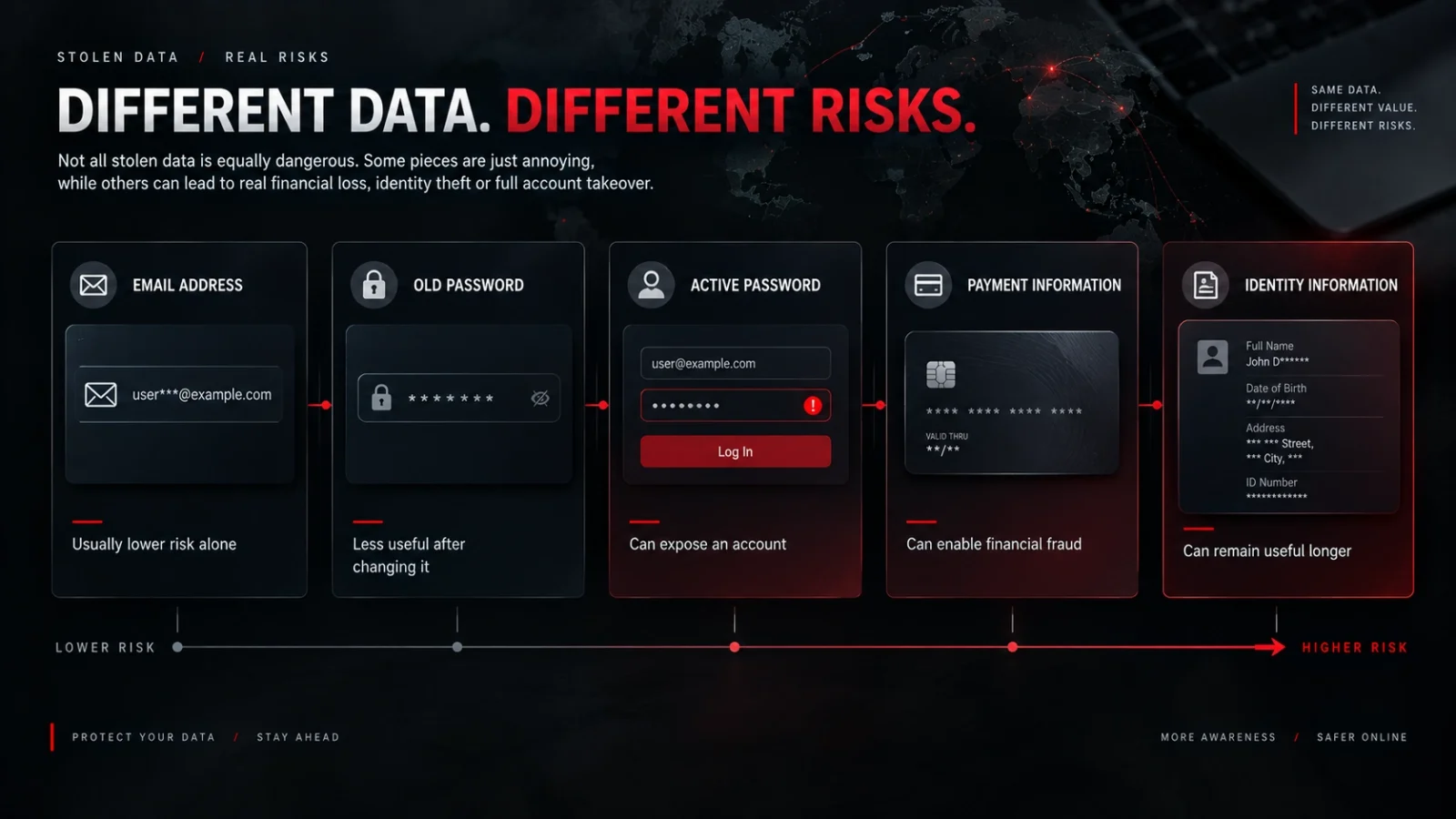
Not all of it matters the same amount. Here is the ladder, from mild to serious.
- Email address alone. Mostly means more spam and phishing.
- An old password. Harmless once you have changed it. Dangerous if you have not.
- A password you still use. This is the one that loses accounts.
- Payment details. Straight to financial fraud, though banks can reverse it.
- Identity information. Name, date of birth, ID numbers. You cannot change these.
Notice the last one. You can change a password in a minute. You cannot change your date of birth.
That is why identity data keeps its value for years, long after a password is useless.
It also explains what do hackers do with stolen data that looks boring. They keep it.
Now let us follow a stolen file all the way through, from the break-in to the fraud.
Step 1: The breach
Someone gets into a system and copies a database. That is the whole of step one.
At this point nobody has asked what do hackers do with stolen data yet. The file is just sitting on a server.
The company may not notice for months. The average gap between a break-in and discovery is measured in weeks, not minutes.
That quiet gap matters. Your password is already out while everything still looks normal.
Step 2: Cleaning and packing
What do hackers do with stolen data the moment they have it? They tidy it.
A raw database is messy. Duplicates, broken rows, junk columns. Nobody pays much for mess.
So they clean it into a simple list, usually one line per person:
email@example.com:password123
That format has a name. It is called a combolist, short for combination list.
Combolists get merged, sorted and resold endlessly. A single list can hold records from dozens of separate breaches.
If passwords were stored badly, they get cracked at this stage too. Weak and common passwords fall in seconds.
Step 3: Selling it on
Now it goes to market. Forums, private chat channels, and marketplaces on the dark web.
Here is the part that shocks people. It is cheap.
- A million plain email addresses can go for the price of a sandwich.
- Email and password pairs are worth more, because they can be tested.
- A working login to a bank or shop account is worth far more again.
- A full identity set, with name, address and ID numbers, sits at the top.
The same file is sold again and again. One breach can be resold for years.
Resale is a bigger part of what do hackers do with stolen data than the original theft.
New to how these markets work? Our guide to deep web vs dark web explains the difference in plain words.
Step 4: Actually using it
So what do hackers do with stolen data once they have bought a list? They test it, in bulk.
Software tries every email and password pair against hundreds of popular websites. Thousands of attempts a minute.
Most fail. A small share work, and that small share is the whole business.
It works for one reason only: people reuse passwords. The password from a forum you forgot about is the password on your email.
Once a login works, the account gets drained, resold, or used to reach something better.
That is the short answer to what do hackers do with stolen data: they turn passwords into working accounts.
Who actually buys stolen data?
It helps to know who is on the other end. What do hackers do with stolen data? Mostly, they sell it to other criminals.
There are four common buyers.
- Account testers. They buy lists in bulk and run them against popular sites.
- Fraud crews. They want cards and bank logins they can cash out quickly.
- Scam call centres. They want names, numbers and addresses to sound convincing.
- Other hackers. They want a staff password that opens a company door.
That last buyer is how one leak becomes the next breach. Your stolen work password is somebody’s way in.
So the market feeds itself. That is the uncomfortable part of what do hackers do with stolen data.
How fast does it all happen?
Faster than most people imagine. Here is a rough timeline.
- Day one: the data is copied. Nobody knows yet.
- Within days: it is cleaned and offered to a small circle.
- Within weeks: testing begins against big websites.
- Within months: the company finds out and announces it.
- After that: the file spreads for free and never stops circulating.
Notice the order. The breach notice email usually arrives long after the testing started.
That is why the answer to what do hackers do with stolen data matters before you are told anything. Good habits have to be in place first.
From one record to a full profile
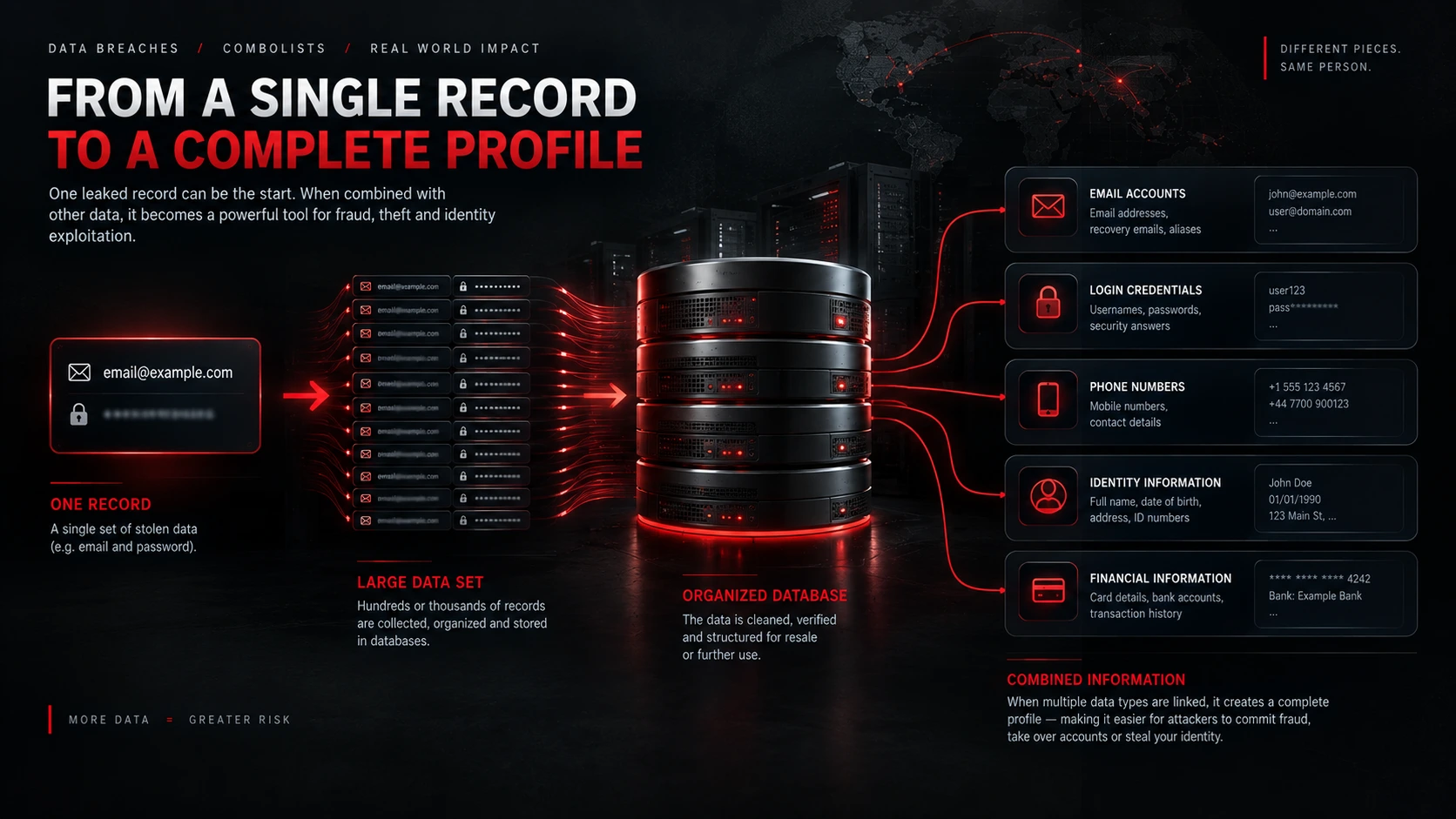
One email and password on its own is a small problem.
The danger comes from joining things up. Your email appears in one breach, your phone number in another, your address in a third.
Match them on the email, and suddenly somebody has a file on you:
- Email addresses and old aliases
- Usernames, passwords and security answers
- Phone numbers
- Full name, date of birth, home address
- Card details and bank information
That is the quiet half of what do hackers do with stolen data. They are not just stealing. They are assembling.
A complete profile is what makes identity theft possible. It is also what makes a scam call sound real.
Profiling is the most damaging thing on the list of what do hackers do with stolen data.
Credential stuffing, explained simply
This is the single most common answer to what do hackers do with stolen data, so it is worth its own section.
Think of a thief with a thousand keys and a street full of doors.
He does not pick any lock. He just tries every key in every door until one opens.
The keys are your leaked passwords. The doors are every site you might have an account on.
Two things stop it completely:
- A different password everywhere. Then one stolen key opens one door, not twenty.
- Two-step login. Then the key alone is not enough to get in.
That is it. Those two habits defeat most of this entire industry.
Stop the key from fitting and you stop most of what do hackers do with stolen data.
When stolen data becomes blackmail
There is a second path, and it targets companies rather than people.
Instead of selling the file, the attacker keeps it and threatens to publish it.
Pay, and they promise to delete it. Refuse, and your customer records appear on a public leak site.
This is what ransomware crews do now, on top of locking files. We broke that model down in how do ransomware gangs work.
For you as a customer, the result is the same. Your details end up in circulation either way.
How long does stolen data stay useful?
Far longer than people expect. There is no expiry date on a leaked file.
- Card numbers: days to weeks, until the card is cancelled.
- Passwords: until you change them. That might be never.
- Email addresses: forever, for spam and phishing.
- Identity details: effectively forever.
A breach from eight years ago can still be the reason you get a convincing scam call today.
Time does not fix what do hackers do with stolen data. Only changed passwords and two-step login do.
Three myths worth dropping
These three beliefs quietly cause most of the damage.
Myth 1: “I am not important enough”
Nobody picked you. What do hackers do with stolen data? They process it in bulk, and bulk includes everyone.
Myth 2: “There is nothing valuable in my account”
The account itself is the value. It can send scams to your contacts, or reset the password on a better account.
Myth 3: “It was years ago, so it is fine”
Old files still circulate. If that password is still in use anywhere, it is still live.
Drop all three and what do hackers do with stolen data stops feeling abstract.
Signs your data is already being used
You rarely get told. You have to spot it yourself.
- Login alerts from places you did not log in from.
- Password reset emails you never asked for.
- Small odd charges on a card, often a test before a bigger one.
- A sudden jump in spam or scam calls.
- Friends getting messages from your account.
- A bill or account appearing in your name that you never opened.
That last one is the serious one. It means somebody is using your identity, not just your password.
These signs are the visible end of what do hackers do with stolen data.
What to do if your data was stolen
Knowing what do hackers do with stolen data is only useful if you act on it. Do these in order.
- Change that password first. Then change it anywhere else you reused it.
- Start with your email account. Whoever controls your email can reset everything else.
- Turn on two-step login on email, banking and social accounts.
- Check your statements for small test charges, not just big ones.
- Report identity theft. In the U.S., IdentityTheft.gov gives you a recovery plan.
- Watch your credit file for accounts you did not open.
Not sure whether you are affected? Follow our steps to check if your email was in a data breach.
How to make your data worthless to them
You cannot stop companies being breached. You can make your records a dead end.
- A different password for every account. This single habit breaks the whole chain.
- Use a password manager. It is the only realistic way to do the above.
- Two-step login everywhere it is offered. Especially email.
- Use an alias email for sign-ups. Then a leak does not touch your real inbox.
- Give less. Shops rarely need your date of birth. Leave optional fields blank.
- Delete old accounts you no longer use. They are still holding your details.
The CISA Secure Our World programme recommends the same short list.
Your browser leaks a surprising amount on its own, too. See what information does my browser share.
Questions people ask
What do hackers do with stolen data, in simple words?
They tidy it into lists, sell those lists cheaply, then test the passwords on other websites. Anything that works gets used or sold again.
Does somebody actually read my emails?
Almost never. It is automated and done in bulk. You are a row in a file, not a target.
How much is my data worth?
On its own, very little. A plain email address is worth a fraction of a penny. A working bank login is worth real money.
What do hackers do with stolen data they cannot use?
They sell it on anyway. Dead passwords still come with live email addresses, and those feed spam and phishing for years.
Is my old password still a risk?
Only if you still use it somewhere, or if it follows an obvious pattern that makes your new one easy to guess.
Can stolen data be deleted?
No. Once a file is copied and shared, it cannot be recalled. You can only reduce what it unlocks.
Why do scam calls know my name and address?
Because several breaches have been joined together into one profile. That detail is what makes the call sound genuine.
Does two-step login really help?
Yes, more than anything else on the list. A stolen password alone stops being enough to get in.
Helpful links and sources
These are the references behind this guide. You can see how we check our work on our sources and research page.
Official guidance
- IdentityTheft.gov: report identity theft and get a recovery plan
- FBI Internet Crime Complaint Center (IC3)
- CISA: Secure Our World
Research and data
More from DeepHiDX
- How to check if your email was in a data breach
- How do ransomware gangs work? 6 roles inside the ransomware business
- What information does my browser share? 10 things websites can see
- How to find where a photo was taken: 7 simple clues
- Deep web vs dark web: 7 simple differences
- Silk Road dark web story: the 3 tools that built a secret market
- Dark web glossary
The short version
So what do hackers do with stolen data? They sort it, sell it, test it, and use whatever still works.
It is a supply chain, not a personal attack. You are a line in a file.
And the whole chain depends on one habit: reused passwords.
Break that habit and most of it stops working on you.


Comments